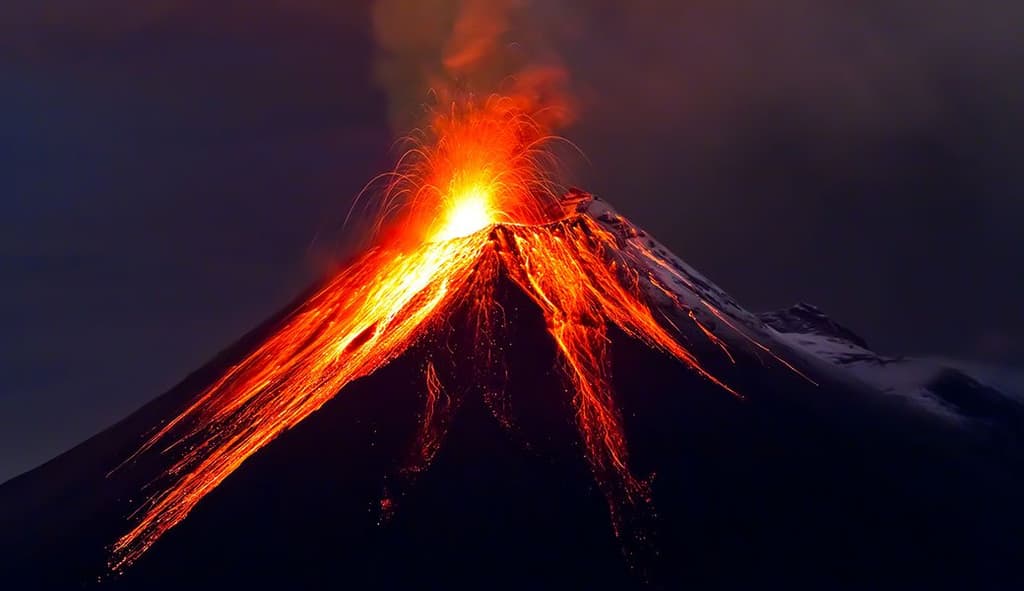
**No VEI ≥4 eruptions have been confirmed in the first half of 2026**, aligning with the market's strong 66.5% implied probability for zero by year-end. The Smithsonian Global Volcanism Program reports 47 total eruptions through mid-June, but these consist primarily of lower-explosivity or ongoing effusive activity at sites such as Kīlauea, Great Sitkin, and various Indonesian and Philippine volcanoes. VEI ≥4 events require explosive ejection of at least 0.1 km³ of material with plumes exceeding 10 km, a threshold met only a handful of times per decade on average. Current monitoring by the USGS and Smithsonian shows no volcanoes exhibiting the rapid pressurization or seismic escalation typical of impending large explosive eruptions, and the single notable submarine event described as the year's largest remains below VEI 4 thresholds. With roughly six months remaining and no major unrest signals, traders assign low odds to even one such eruption occurring before December 31.
Resumen experimental generado por IA con datos de Polymarket. Esto no es asesoramiento de trading y no influye en cómo se resuelve este mercado. · Actualizado¿Cuántas erupciones volcánicas grandes (VEI ≥4) en 2026?
¿Cuántas erupciones volcánicas grandes (VEI ≥4) en 2026?
0 67%
1 20%
2 4.6%
3 1.2%
$1,145,718 Vol.
$1,145,718 Vol.
0
67%
1
20%
2
5%
3
1%
4
1%
5+
1%
0 67%
1 20%
2 4.6%
3 1.2%
$1,145,718 Vol.
$1,145,718 Vol.
0
67%
1
20%
2
5%
3
1%
4
1%
5+
1%
The primary resolution source will be the Smithsonian Institution Global Volcanism Program (GVP: https://volcano.si.edu/), specifically the cumulative figures for 2026 for VEI 4, VEI 5, and VEI 6 released on the page currently titled "Eruptions Avg 2000-2024 (N/T)" (https://volcano.si.edu/faq/index.cfm?question=eruptionsbyyear) as of March 31, 2027, 12 PM ET. Any prior updates will not be considered finalized.
If this dataset has not been updated to include all relevant events by March 31, 2027, or if the Smithsonian GVP becomes permanently unavailable, this market may resolve based on a consensus of credible scientific sources, including the U.S. Geological Survey (USGS), national or regional volcanic observatories, or credible reporting of a scientific consensus.
Note: Smithsonian Institution Global Volcanism Program databases, which include eruptions that reached the relevant threshold prior to this market’s timeframe (e.g., https://volcano.si.edu/faq/index.cfm?question=eruptionsbyyear&checkyear=2025), will not be considered.
Mercado abierto: Jan 2, 2026, 1:48 PM ET
Resolver
0x2F5e3684c...The primary resolution source will be the Smithsonian Institution Global Volcanism Program (GVP: https://volcano.si.edu/), specifically the cumulative figures for 2026 for VEI 4, VEI 5, and VEI 6 released on the page currently titled "Eruptions Avg 2000-2024 (N/T)" (https://volcano.si.edu/faq/index.cfm?question=eruptionsbyyear) as of March 31, 2027, 12 PM ET. Any prior updates will not be considered finalized.
If this dataset has not been updated to include all relevant events by March 31, 2027, or if the Smithsonian GVP becomes permanently unavailable, this market may resolve based on a consensus of credible scientific sources, including the U.S. Geological Survey (USGS), national or regional volcanic observatories, or credible reporting of a scientific consensus.
Note: Smithsonian Institution Global Volcanism Program databases, which include eruptions that reached the relevant threshold prior to this market’s timeframe (e.g., https://volcano.si.edu/faq/index.cfm?question=eruptionsbyyear&checkyear=2025), will not be considered.
Resolver
0x2F5e3684c...**No VEI ≥4 eruptions have been confirmed in the first half of 2026**, aligning with the market's strong 66.5% implied probability for zero by year-end. The Smithsonian Global Volcanism Program reports 47 total eruptions through mid-June, but these consist primarily of lower-explosivity or ongoing effusive activity at sites such as Kīlauea, Great Sitkin, and various Indonesian and Philippine volcanoes. VEI ≥4 events require explosive ejection of at least 0.1 km³ of material with plumes exceeding 10 km, a threshold met only a handful of times per decade on average. Current monitoring by the USGS and Smithsonian shows no volcanoes exhibiting the rapid pressurization or seismic escalation typical of impending large explosive eruptions, and the single notable submarine event described as the year's largest remains below VEI 4 thresholds. With roughly six months remaining and no major unrest signals, traders assign low odds to even one such eruption occurring before December 31.
Resumen experimental generado por IA con datos de Polymarket. Esto no es asesoramiento de trading y no influye en cómo se resuelve este mercado. · Actualizado
Cuidado con los enlaces externos.
Cuidado con los enlaces externos.
Preguntas frecuentes